China Top 10 Hospital Chair Manufacturers for Global Buyers
Choosing a hospital chair supplier requires more than comparing prices and catalogue images. Global buyers must examine product safety, material quality, factory capability, customization support, and after-sales reliability. This guide introduces ten leading Chinese hospital chair manufacturers serving international healthcare markets.
The selection focuses on practical evidence, including production experience, export history, quality-control procedures, and product application. A dependable manufacturer should understand infection-control needs, patient comfort, load capacity, cleaning routines, and the daily pressure faced by nurses and visitors. Details matter. Welded joints should look consistent. Upholstery should resist frequent disinfection. Armrests must feel stable, not merely attractive.
China’s medical furniture sector includes both established factories and newer suppliers with strong design teams. However, not every impressive website proves manufacturing strength. That is worth remembering. Buyers should request samples, technical documents, certifications, and recent project references before making a decision. A hospital chair may appear simple, yet its performance affects comfort, workflow, and long-term maintenance costs.
The manufacturers featured here are assessed from a buyer’s perspective. Their product ranges, production strengths, customization options, and international service capabilities are considered. Some may excel in patient seating, while others focus on waiting areas, treatment rooms, or reclining solutions. No single supplier fits every hospital. Careful comparison remains essential.
This overview is designed to support informed sourcing decisions. It does not replace independent audits or local compliance checks. Still, it offers a practical starting point for hospitals, distributors, contractors, and healthcare procurement teams seeking reliable Chinese partners.
What Defines a High-Quality Hospital Chair Manufacturer?
A high-quality hospital chair manufacturer understands clinical routines, not only furniture design. Nurses need chairs that move smoothly, lock securely, and remain stable during patient transfers. Patients need supportive seats, clear armrests, and surfaces that feel comfortable for longer stays. Small details matter. A sharp edge or weak caster can create daily frustration.
Reliable manufacturers use documented material testing, load testing, and quality inspections at several production stages. They should explain the chair’s weight capacity, frame construction, fire performance, and cleaning resistance in clear language.
Upholstery must tolerate repeated disinfection without cracking or fading quickly. Factories should also provide traceable batch records, sample approvals, and replacement-part information. Vague promises are not enough.
Experience becomes visible during factory audits. Buyers can inspect welding points, stitching, caster alignment, packaging, and final inspection records. A dependable supplier welcomes these questions and responds with practical evidence. No factory is flawless. That is worth remembering. The stronger manufacturer identifies defects early, records corrective action, and improves the process instead of hiding problems. After delivery, responsive technical support, realistic lead times, and consistent spare-part availability protect hospital operations. A low purchase price may look attractive, but poor durability can increase maintenance work and replacement costs. Reliability is measured over years, not during one showroom visit.
China’s Top 10 Hospital Chair Manufacturers
China’s Top 10 Hospital Chair Manufacturers
China’s top 10 hospital chair manufacturers are increasingly evaluated beyond price. China’s National Health Commission reported total health expenditure of about RMB 9.06 trillion in 2023. That investment increases demand for safer, cleaner, and more durable patient seating. Buyers should examine load testing, frame strength, upholstery performance, and spare-part availability. Appearance is not enough.
The World Health Organization expects one in six people worldwide to be aged 60 or older by 2030. This shift makes transfer support, stable armrests, and easy-clean surfaces more important in hospitals. Leading Chinese manufacturers often provide treatment chairs, dialysis chairs, infusion recliners, and visitor seating. Their practical advantage is flexible production. Custom dimensions and export packaging are usually easier to discuss directly with factories.
A reliable supplier should provide test records, material specifications, factory quality procedures, and clear warranty terms. ISO 9001 certification can indicate process control, but it cannot prove every chair is comfortable or durable. This is where buyers need independent checks. Request samples, inspect welds, measure recline movement, and test cleaning agents used in the target hospital. Some product pages still make broad claims without enough evidence. That weakness deserves attention before placing a large order.
Key Products and Applications in Healthcare Settings
China Top 10 Hospital Chair Manufacturers for Global Buyers
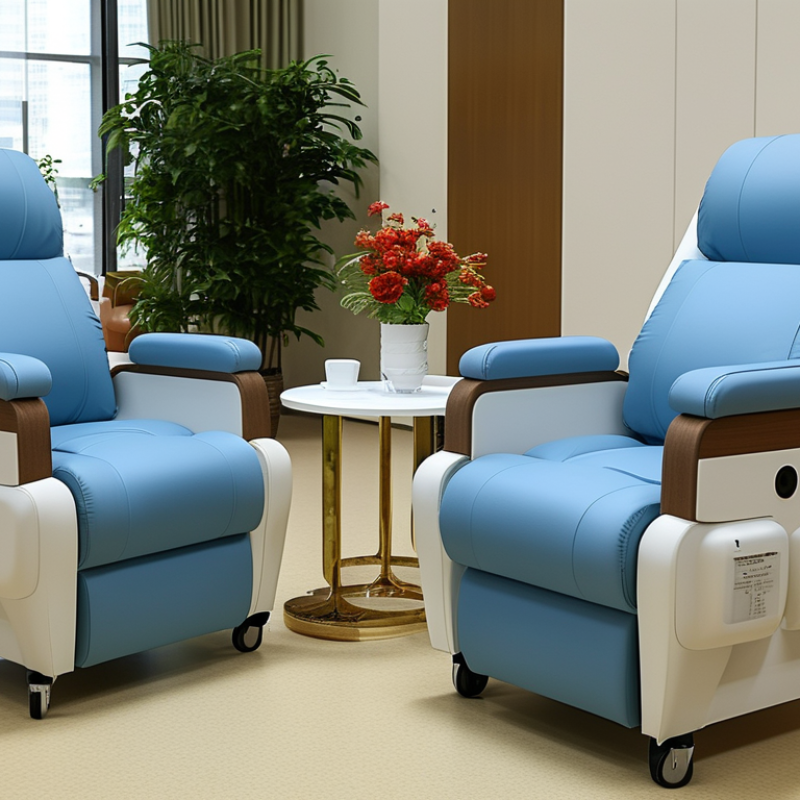
For global buyers, hospital chairs must match real clinical work, not only showroom photos. Key products include electric patient recliners, infusion chairs, dialysis chairs, bariatric chairs, transfer chairs, and visitor seating. Each serves a different setting. Infusion chairs need stable arm supports and easy-clean upholstery. Dialysis chairs require controlled positioning and dependable load capacity. Waiting-area chairs need impact resistance and simple maintenance.
The World Health Organization’s Global Patient Safety Report 2024 states that about one in ten patients experiences harm during healthcare delivery. The U.S. CDC also reports that roughly one in 31 hospital patients has a healthcare-associated infection on any day. These figures make cleanable surfaces, sealed seams, corrosion-resistant frames, and removable cushions important purchasing factors. Buyers should request load testing, cycle testing, material specifications, and traceable quality records. However, certificates alone do not prove daily comfort. That assumption needs review.
Tips: Compare seat width, height range, braking systems, cushion density, and cleaning compatibility. Ask manufacturers for user manuals, spare-part plans, and sample chairs. Check performance in a real ward. A chair that feels strong may still be awkward for nurses. Pilot testing exposes those gaps. Also verify whether powered models meet the electrical and medical-device requirements of the destination market. Source data: WHO Global Patient Safety Report 2024; U.S. CDC National Healthcare Safety Network, 2020 survey.